
An enterprise customer estimated that its employees were spinning up about 500 AI agents a week. Then a monitoring tool went looking and found 2,000 already built.
The number that matters is four times the estimate, and nobody at the company knew it until they bought an instrument to count them. Andrew Boyd of Dataiku tells that story often, because he sells the instrument.
Now here is the number that ought to be on every agentic-commerce slide deck and is not.
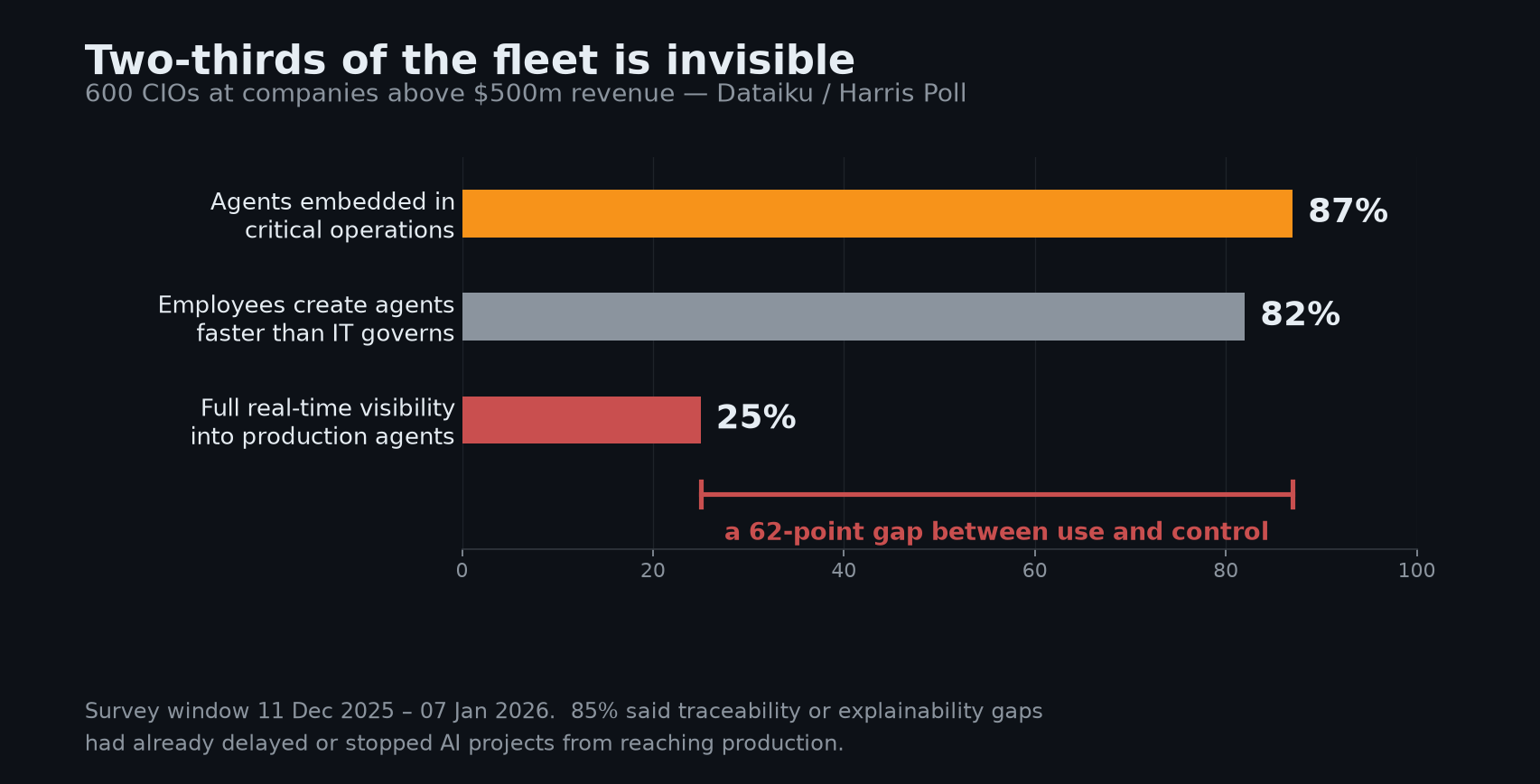
In a Dataiku/Harris Poll of 600 CIOs at companies above $500 million in revenue, 87% said AI agents were already embedded in critical operations. Only 25% had full real-time visibility into every agent running in production. And 82% admitted their employees create agents faster than IT can govern them.
Two-thirds of an enterprise agent fleet is running somewhere nobody can see it. That is the actual state of the agentic economy in 2026: a compliance problem with a market attached to it.
The forecasts are a distraction from the binding constraint
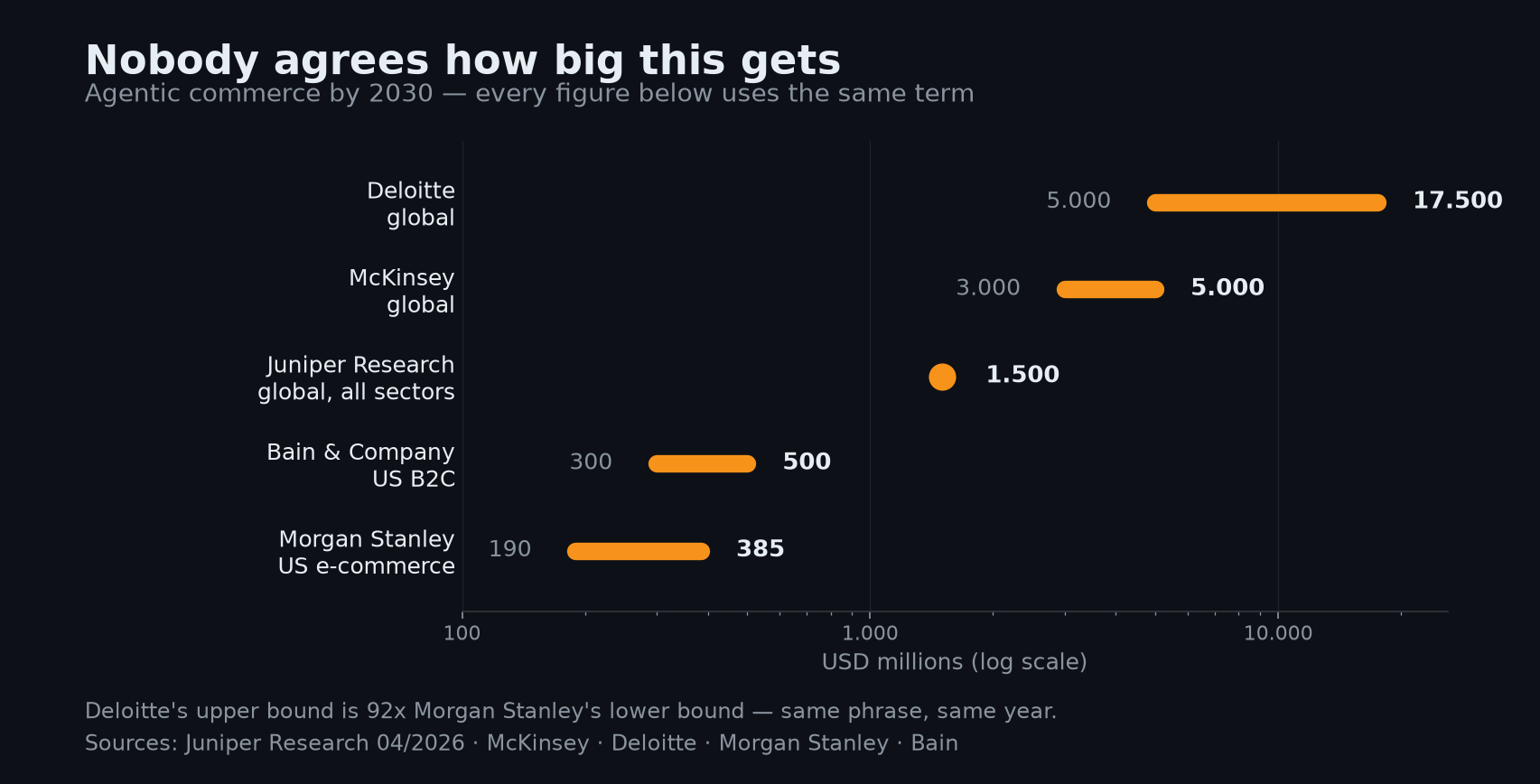
The projections are everywhere. Juniper Research puts agentic commerce at $1.5 trillion by 2030, up from $8 billion in 2026. McKinsey says $3–5 trillion. Deloitte says $17.5 trillion. Morgan Stanley, measuring only US e-commerce, says $190–385 billion.
The high estimate is 92 times the low one. Every institution uses the same phrase and measures something different. That spread is not a disagreement about the opportunity; it is evidence that the methodology does not exist yet.
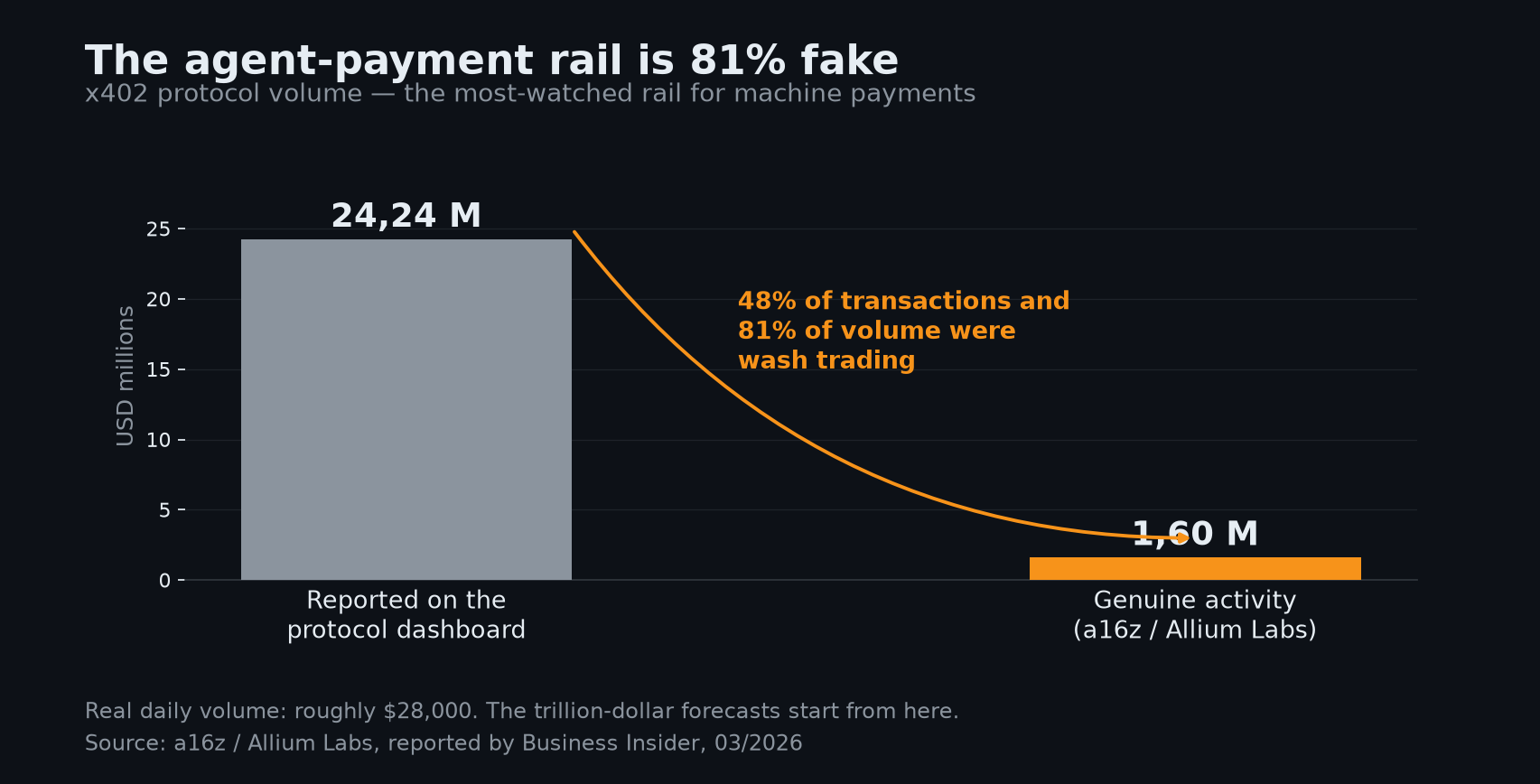
Meanwhile the real transaction volume on the most-watched agent payment rail, x402, is $28,000 a day. Two a16z-linked researchers, Noah Levine and Allium Labs, filtered the protocol's $24.24 million in reported volume and found about $1.6 million that was genuine. 48% of transactions and 81% of volume were wash trading.
Getting from $28,000 a day to $1.5 trillion a year would require a leap that no payment rail has ever made.
But the reason to doubt the forecasts is not that they are too large. It is that they are measuring the wrong thing. The constraint on autonomous agents is not capital or model quality. It is that 85% of CIOs said traceability or explainability gaps had already delayed or stopped AI projects from reaching production (Dataiku/Harris, December 2025–January 2026).
Agents are not blocked because they cannot pay. They are blocked because nobody can prove what they did.
The evidence that agents are already here

This is not a pilot phase. Salesforce's Agentic Enterprise Index, published August 2026, tracks agents on its platform across thousands of businesses. In February 2025 the average organisation had activated five agents. By April 2026 it was thirteen — a 7% compound monthly growth rate sustained over fifteen months rather than a spike from a handful of large accounts.
The time to create and deploy a new agent fell 53%, to 1.9 days. And agent output, measured in discrete completed tasks, is growing at a 15% compound monthly rate.
At honeycomb.io, nearly 20% of all monthly interactive queries are now made by agents rather than merely assisted by them.
Model Context Protocol crossed 10,000 active public servers in March 2026. 28% of the Fortune 500 have MCP servers in production. In July 2026 the protocol shipped Enterprise-Managed Authorisation as a stable extension, a centralised way for organisations to control agent access through their identity provider.
Read that last item carefully, because it tells you which way the wind is blowing. The enterprise answer to governing agents is to route their permissions through a company's own identity provider. That works as long as the agent works for the company. It is silent on what happens when an agent needs to prove something to someone outside it.
Why the card networks cannot solve this

The incumbents are serious and they are ahead. Stripe co-developed the Agentic Commerce Protocol with OpenAI and powers ChatGPT's Instant Checkout. Mastercard built Agent Pay; Visa built Intelligent Commerce. x402 has roughly 40,000 active wallets.
All of them solve the same problem: an agent acting on behalf of a verified human. The human's identity is inherited, the card is the human's card, and the liability sits with the human.
That model breaks at the point agents transact with each other. When there is no consumer behind either side, there is no identity to inherit, no cardholder to underwrite, and no chargeback to reverse. Pantera Capital made this argument plainly: blockchain rails become critical at the level where agents deal directly with agents.
An agent cannot open a bank account. It has no passport, no address, no signature a compliance officer would accept. But it can generate a keypair in a millisecond, and a keypair provides the three things the enterprise governance stack is failing to provide:
Settlement it can trigger itself. Not a monthly subscription sized for an average someone guessed, but payment per API call, per inference, per second of compute. Lightning settles in milliseconds for a fraction of a cent. A $0.0003 payment is impossible on a card rail and trivial on Lightning.
Identity that no registrar can revoke. An npub is not an account. It cannot be suspended, rate-limited, or migrated out of existence. For a person that is a nice property. For an agent it is the difference between existing and not.
An audit trail verifiable without trusting anyone. Every event is signed and anyone can check it. The record does not depend on a counterparty's honesty or a platform's retention policy, which is precisely what 85% of those CIOs said they were missing.
What is already running
The numbers on Lightning are unglamorous, and that is the point.
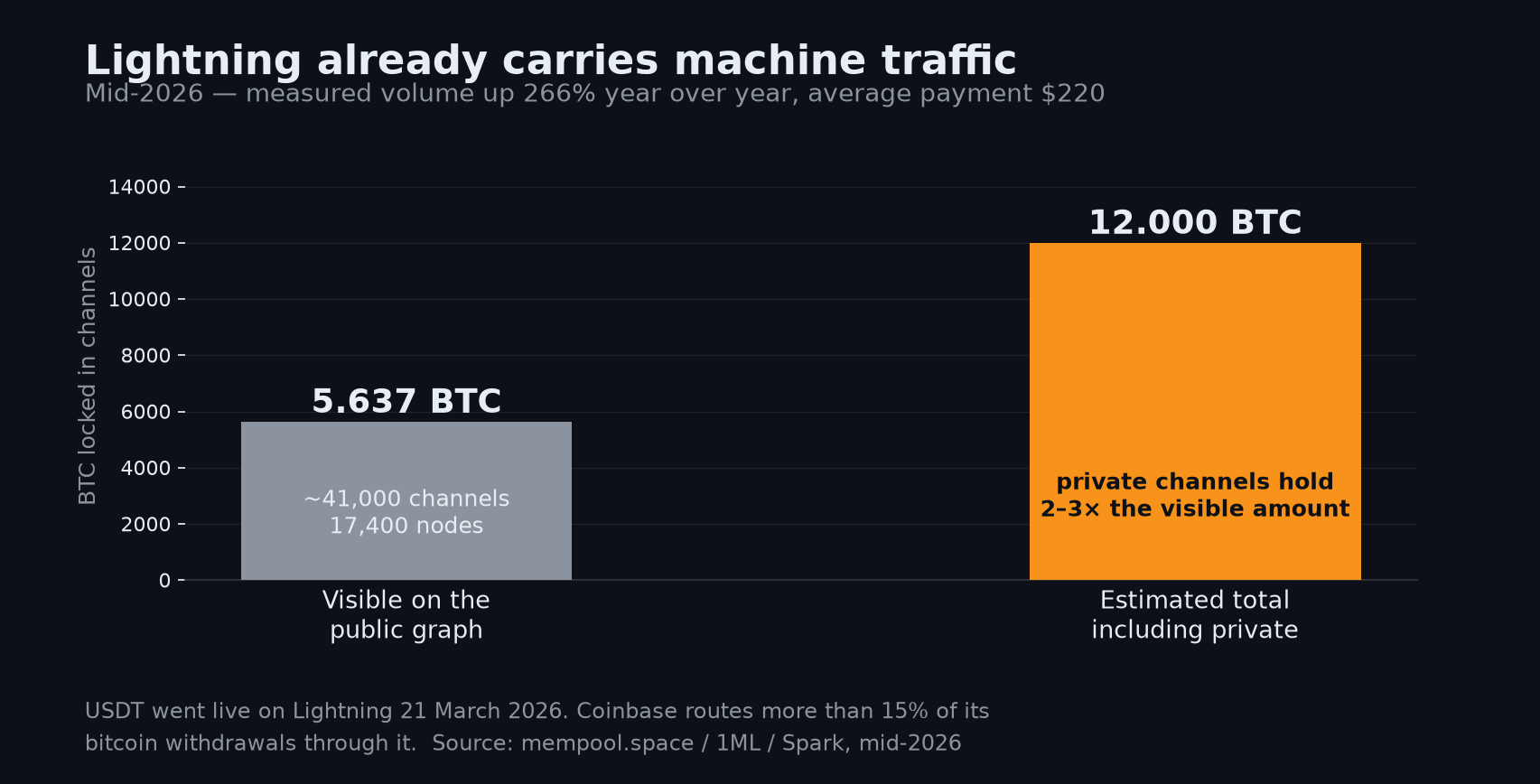
Public capacity sits at 5,637 BTC across roughly 41,000 channels and 17,400 nodes, with private channels estimated to hold two to three times as much, above 12,000 BTC in total (mempool.space / 1ML / Spark, mid-2026). Publicly measured payment volume is up 266% year over year, running above $1.1 billion a month, at an average payment size of about $220.
Node counts on the public graph have fallen, which the headline-chasers read as decline. The plumbing says otherwise: hobbyist operators left, professional routing nodes absorbed the liquidity, and the network came out denser while looking smaller.
Two changes matter more than the totals. On 21 March 2026 USDT went live on Lightning through Lightning Labs' Taproot Assets, ending the argument that a dollar-denominated machine payment has no place on a Bitcoin rail. And Coinbase said that by mid-2025 more than 15% of its bitcoin withdrawals were routing through Lightning; Binance, Kraken, OKX and Cash App followed, with Block rolling Lightning out to roughly four million US point-of-sale merchants.
The rail worked, and the volume followed.
And then a company gave agents their own keys
On 21 July 2026, Block, Jack Dorsey's company, released Buzz: an Apache-2.0 workspace where AI agents join channels as first-class members with their own keypairs and permissions, rather than as bots borrowing a human's account. It shipped with harnesses for Goose, Codex and Claude Code and took 7,600 GitHub stars in three days.
The star count is not the interesting part. The interesting part is the architectural choice, and why it was forced.
If a digital worker needs its own permissions and its own audit trail, it needs an identity that belongs to the worker. A bot borrowing a human's account can never have one, because every action is recorded under the human and revoking the human destroys the record. Block needed an identity with no registrar. Nostr was the shortest path to one.
The order matters. The governance requirement came first, and it produced the decentralised answer.
The strongest case against everything above
Pretending this is settled would be dishonest. The evidence points both ways.
The incumbents are better funded and already integrated. Four million merchants take card payments. Forty thousand wallets use x402. Stripe, Visa and Mastercard are building agent authentication into rails that already exist everywhere.
The bottleneck is psychological, not technical. McKinsey's own survey data: 63% of European consumers use AI to compare options when shopping, but 47% are uncomfortable letting an agent manage recurring purchases autonomously. Delegating money to software is a trust problem before it is a plumbing problem — and trust problems move in decades, not quarters.
The forecasts may simply be wrong. A spread from $190 billion to $17.5 trillion tells you the methodology is unstable. A real market can still arrive thirty years later than the projections promised. And the honest reading of $28,000 in real daily volume is that autonomous agent payments are, today, close to nothing.
And autonomy may never arrive the way the enthusiasts assume. Every enterprise governance tool shipping right now is designed to keep a human responsible for what the agent did. If that holds, and agents remain supervised instruments rather than independent economic actors, then the inherited-identity model is sufficient and none of the above is necessary.
What I could not verify
I have no reliable measurement of how much agent traffic runs over Lightning specifically. The 266% volume growth is network-wide. The argument that agents will route through Lightning is structural, not measured, and I would rather say that than borrow credibility I have not earned.
I also cannot tell you how many of those 41,000 public channels carry machine traffic at all. Nobody publishing numbers appears to be measuring it — which is itself the point of this piece, arriving one level up. We are back where Boyd's customer started: counting things nobody had counted.
The consequence
The trillion-dollar figures will be revised, probably downward, probably more than once. In five years Juniper's $1.5 trillion will look either prescient or absurd and nobody today can tell you which.
What does not move is the constraint that produced the 2,000 uncounted agents. Somewhere in that fleet, an agent did something with money, and no one can produce a record of it that a third party would accept.
Every bank on earth is built to prevent software from doing exactly that. Bitcoin and Lightning permit it without asking permission. Nostr extends the same logic from money to identity, and a company that needed both arrived there independently, under no ideological pressure, because the alternative did not exist.
The agents will not choose these rails because the projections are large. They will use whatever lets them act when nobody is willing to vouch for them, and the cost of a keypair is nothing next to the cost of a compliance officer.
That is a much smaller claim than $17.5 trillion. It is also the one that survives being wrong about the forecast.